Changing Rabies Requirements for Pets
“Why can’t titers be accepted instead of a rabies vaccine?” “Why is rabies vaccination required for every dog – what if they have a medical condition?” “Why can’t the rabies laws be changed?” These are questions owners ask me all the time. I’m going to share the basic answers here, so pin this post, save it, share it, whatever allows you to reference it in the future.
The first thing you need to know is that rabies is a fatal disease, and is classified as zoonotic, meaning it can be spread from animals to humans. The most likely animals to be affected are bats, skunks, foxes, and raccoons. However, any mammal can be infected, including horses, cattle, dogs, cats, ferrets, deer, beavers, and more. The infection is spread through a bite or contact of infected tissues with a wound. Once in the body, the rabies virus travels up the nerves to the brain. Signs are usually neurological in nature, ranging from disorientation to seizures, and erratic behaviors including aggression, wandering, clumsiness, and stupor. Animals usually die within days of signs appearing.
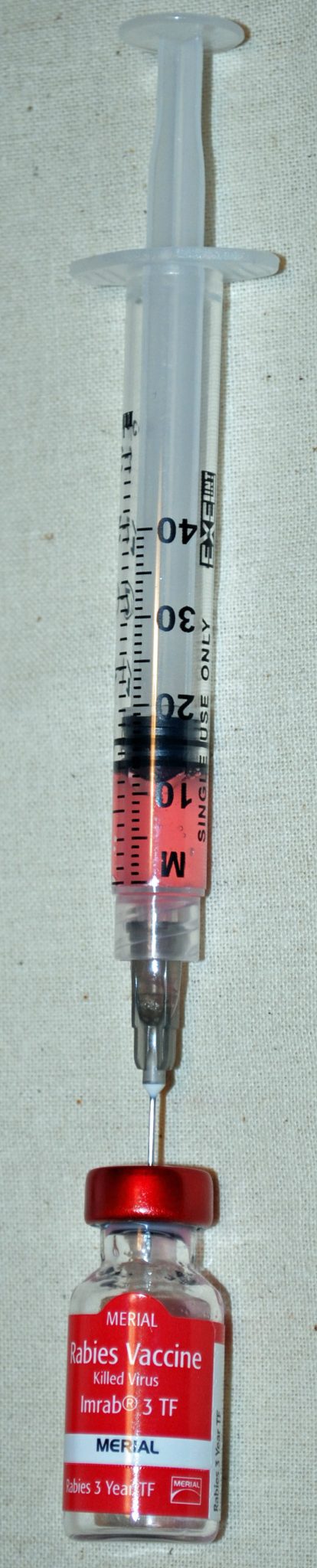
Vaccination against the rabies virus is very effective. There are a number of vaccines available, with the majority containing killed rabies virus as the antigen. New mRNA vaccines are under development, but none are available for humans. A canine/feline mRNA vaccine exists, but is not yet widely used. Mercury free products are available, and likely pose less risk than mercury containing products.
The legal requirement to vaccinate against rabies is stipulated at the state level. Dogs, cats, and ferrets are required to be vaccinated by most states. Livestock may be vaccinated in high-risk areas, which makes sense as their potential exposure to infected wildlife is high if they are on pasture. A USDA approved vaccine must be used, according to its label. This means that a vaccine labelled as a 1 year vaccine must be boostered in a year, and a 3 year vaccine in 3 years. Most or all states will also specify a minimum age by which animals must be vaccinated, and that the first ever rabies vaccine must be boostered in a year, regardless of product used.
The requirement to vaccinate according to label means that the full dose must be given to the animal. Splitting or half dosing is considered off label, and could have legal repercussions for the veterinarian who administered the vaccine. Please do not ask your veterinarian to do this, as it puts them in an ethical and legal dilemma, and while rare, veterinarians have had challenges to their licenses (in other words their means to make a living), from underdosing.
Fortunately, the labels also stipulate to vaccinate only healthy animals. Many states have provisions for the exemption of animals that have a serious chronic health condition that makes vaccination risky for them. These could include autoimmune diseases, cancer, concurrent chemotherapy, etc. Less severe conditions such as allergies, arthritis, and old age do not meet the criteria for most exemptions.
Fortunately, the labels also stipulate to vaccinate only healthy animals. Many states have provisions for the exemption of animals that have a serious chronic health condition that makes vaccination risky for them. These could include autoimmune diseases, cancer, concurrent chemotherapy, etc. Less severe conditions such as allergies, arthritis, and old age do not meet the criteria for most exemptions.
So what about changing the laws? Many owners know that the Rabies Challenge Fund study showed a duration of immunity of 6 years in 80% of study dogs. The study used 2 different vaccine products, both labelled for a 3 year duration of immunity. Click here to read the published report.
To change the laws to reflect the longer level of immunity, each vaccine would have to be relabeled. That means a study to USDA standards for however many years the vaccine manufacturer wanted the label to reflect. So, hypothetically, each study would take 5 – 6 years if based on the Rabies Challenge Fund data. Given that there is only one facility in the country that can do this testing (as they are approved to handle a zoonotic, fatal disease causing virus and animals that may be infected by it), this would be a lengthy and expensive process. It would also greatly increase the price of rabies vaccines, as the manufacturer recoups the millions of dollars spent on the testing and approvals. (For reference, the Rabies Challenge Fund study exceeded $1.25 million, and took place over 10 years ago).

So, the logical alternative is the approval of titers as alternative to boostering automatically per the vaccine label. Many people are aware that titers are part of the process of admission to rabies free countries for dogs and cats, along with vaccination. In my opinion, the science behind titers is sound, and in the case of vaccinated animals, demonstrates that they have responded to the vaccine given. Assuming states were to change their laws, and accept titers, a few details would have be decided upon. First, would the accepted titer be a minimum, or an actual quantified level (endpoint)? What would the accepted levels be? How often would the titer need to be repeated? Would veterinarians have to be approved to submit these titers? Would the animal need to be permanently identified with a tattoo or microchip to ensure truthful sample? There are only 3 labs currently approved in the US currently CDC approved laboratories – would they be able to handle the potential influx of so many samples in a timely manner?? And what if some states accepted titers, but neighboring ones did not – – would the pet be “illegal” in those states but “legal” in their home state? What if a titered dog bit a child in a state that did not accept titers? International travel will still require vaccination, and for some countries animals may require 2 doses of vaccine given 30 days apart, and another 30-day waiting period before travel, as titers are not considered a substitute for vaccination.
As you are hopefully now understanding, changing rabies requirements is not a simple matter. It will be costly on many levels, and would take years to implement. It could be very confusing as laws are state based. It could greatly complicate travel and use of facilities that require proof of rabies, from boarding kennels to state parks to airlines for both national and international travel.
Inappropriate vaccination and redundant vaccination (administering a vaccine when the pet is already immune) is of little benefit and potential harm. I will always advocate for more science-based legislation, for the benefit of our pets’ health. However, I believe it is vital to understand the processes that would need to take place in any changes, as well as the implications for pet owners, facilities, services, and enforcement agencies.
Resources: