Will History Repeat Itself?
“Those who cannot remember the past are condemned to repeat it.” – George Santayana famously wrote in 1905. And it remains as true today as ever, as Merck Animal Health gained FDA approval for its new Bravecto Quantm, a 12 month flea and tick product for dogs, administered by injection by veterinarians. Pricing is expected to be $350 – $400 per dog, adding upwards of $500 million in annual revenue for Merck.

Perhaps you remember this history of another long-acting injectable product for heartworm protection, Proheart 6. It was widely used by owners and veterinarians for its convenience and guaranteed protection. It was approved in 2001, but after over 5,000 reports of adverse reactions, including deaths, FDA required a recall and production stoppage in 2004. Fort Dodge brought the product back to market in 2008, under a “risk minimization program.” It was the first veterinary product to be marketed and distributed under such a program. Per the above link, “The risk minimization and restricted distribution program is intended to educate veterinarians and pet owners regarding the possible risks associated with the use of ProHeart 6. Therefore, Fort Dodge is requiring veterinarians who wish to purchase ProHeart 6 to register with the company and participate in a Web-based training program prior to obtaining the product.” Owners were also required to read and sign a permission statement. Similar rules are in place for ProHeart12, the 12-month version of the product.
So, do you think history is going to repeat itself? I worry most about injectable products, but let’s look at what happened with oral forms of Bravecto, as well as the other oral pesticide products. I wrote about this in 2018, when after releasing the products to the market with minimal field testing, it became obvious that dogs were suffering neurological side effects, including seizures. And now the products must carry the warning not to administer to dogs who have already suffered a seizure or are considered epileptic, as well as the adverse neurological event warning.

Just like the oral products, injectable Bravecto Quantum was tested on a small number of dogs (especially considering the high sales number predicted in an article linked above). Group 1 dogs received the product once a year. The other groups received the product more often. Complete details can be found at the FDA links at the bottom of this page.
A total of 274 dogs participated in the field approval study — do you think they accurately represent the 100 million dogs estimated to live in the US?
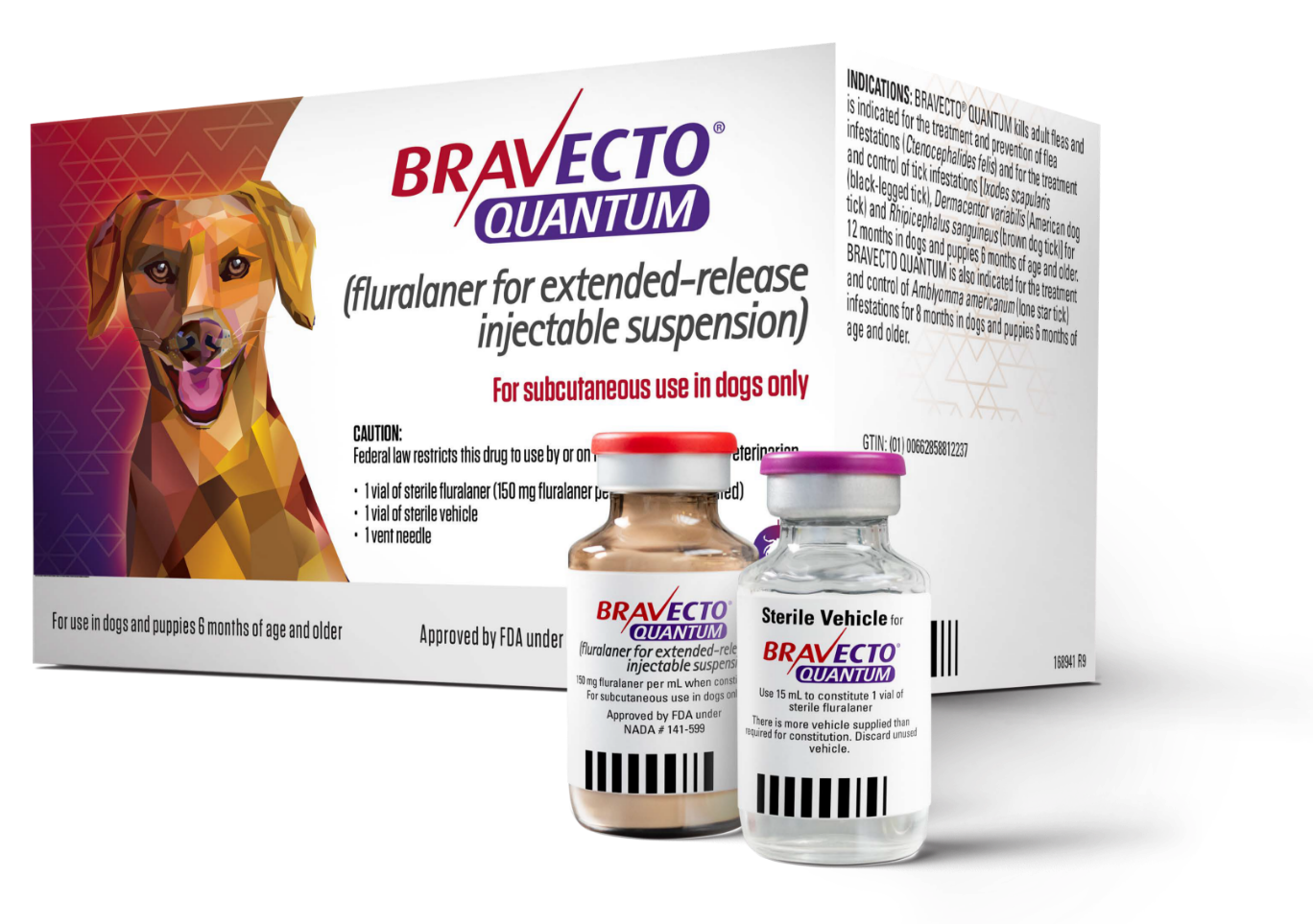
Would you give this product to your dog, especially knowing that you can not remove it from the dog’s body for 12 months? Knowing that the fleas and ticks will still bite your dog, putting him at risk for tick-borne diseases? I suspect the company will deny this, but it has occurred in dogs at our practice, with dogs that tested negative previously, switched to oral Bravecto or related products, and subsequently tested positive for Lyme, Anaplasmosis, or Ehrlichia, despite the company’s claims to the contrary. Do you think history will repeat itself, with ithis product being pulled from the market like ProHeart6?